
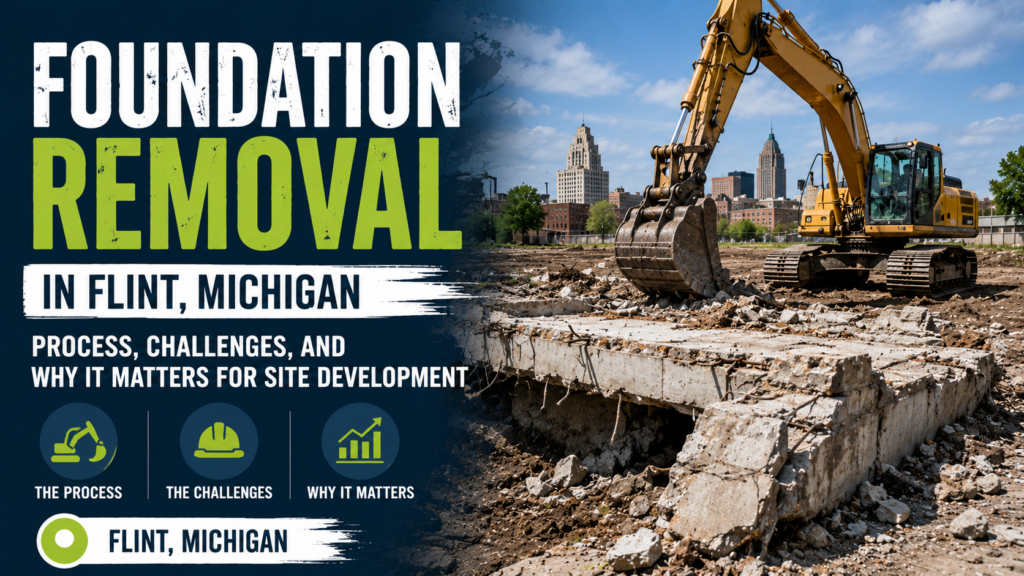
Foundation removal is a specialized construction service that is often required after a building has been demolished, abandoned in place, or when a property is being prepared for new development. In Flint, Michigan, where the urban landscape includes a significant number of properties that have undergone demolition or been cleared of deteriorating structures, Foundation Removal Flint is a frequent and critical step in making parcels truly development-ready. Understanding what foundation removal involves, why it is necessary, and what to expect from the process helps property owners and developers plan effectively.
What Is Foundation Removal?
Foundation removal is the process of excavating and removing the existing concrete, masonry, or block foundation of a demolished or cleared structure from the ground. After a building is taken down either through scheduled demolition or natural deterioration the foundation walls, footings, and floor slabs often remain buried below grade, even when the above-ground structure has been cleared away.
These remnant foundations may be invisible at the surface but represent significant obstacles to new construction or landscape use. They can interfere with utility installation, prevent proper grading and drainage, and create hidden structural problems if new construction is attempted above them without proper removal.
Why Old Foundations Cannot Simply Be Left in Place
One of the most common misconceptions in site redevelopment is that a buried foundation can be left where it is and built over or around. In most cases, this approach creates serious long-term problems:
- Structural incompatibility: New construction requires engineered foundations designed for the specific structure above them. Old foundations of unknown condition, design, or depth cannot reliably serve new structural needs.
- Drainage interference: Old foundation walls and slabs can impede subsurface water flow, creating drainage problems that affect both the new structure and adjacent properties.
- Soil contamination: In older Flint properties, foundations may have been in contact with lead-based paints, petroleum products, or other contaminants that require remediation.
- Legal and permitting requirements: Many municipalities, including Flint, require that old foundations be removed and the site properly graded before permits for new construction are issued.
Types of Foundations Encountered in Flint
Flint’s building stock spans a broad historical range, and the types of foundations contractors encounter reflect this history:
- Poured concrete foundations: Common in structures built after the mid-20th century. These are typically the most robust and require heavy equipment to break up and remove.
- Concrete block foundations: Frequently found in residential properties from the 1940s through 1970s. Individual blocks may be more easily removed than monolithic poured concrete but can still present challenges when filled with mortar.
- Stone and rubble foundations: Rare but present in the oldest structures in Flint. These may be more easily removed but can be unpredictable in terms of subsurface depth and extent.
- Concrete slabs: Flat slabs at grade or slightly below grade are common in commercial and industrial properties and require careful breaking and removal.
The Foundation Removal Process
A typical foundation removal project in Flint follows a defined sequence:
- Site assessment and utility marking: Before excavation begins, the contractor assesses the extent of the foundation and the depth of underground utilities in the area. PA One Call equivalents Michigan’s MISS DIG 811 system must be contacted to mark buried utility lines.
- Initial excavation: Excavators remove soil around and above the foundation to expose it fully and provide working room for equipment.
- Concrete breaking and demolition: Hydraulic breaker attachments on excavators are used to break up poured concrete foundation walls, footings, and slabs into manageable sections.
- Material removal: Broken concrete and masonry is loaded into dump trucks and hauled to processing or disposal facilities. Much of the concrete can be recycled into crushed aggregate.
- Backfilling and compaction: Once the foundation is removed, the excavated area is backfilled with clean fill material and compacted in lifts to prevent future settlement.
- Site grading: The surface is graded to appropriate drainage slopes and contours to prepare for the site’s next use.
Hazardous Material Considerations in Foundation Removal
In older Flint properties, foundation removal may intersect with environmental concerns. Lead-based paints from the interior of former basements may be present on foundation walls. Underground storage tanks (USTs) once common in residential properties for heating oil and in commercial properties for fuel may be discovered during excavation. The presence of USTs requires notification of the Michigan Department of Environment, Great Lakes, and Energy (EGLE) and proper removal and remediation protocols.
Asbestos-containing materials such as pipe insulation from old mechanical systems may also be encountered during foundation removal in properties where pre-demolition abatement was incomplete. Contractors must be prepared to stop work and coordinate with licensed abatement professionals if regulated materials are discovered during excavation.
Foundation Removal in the Context of Blight Demolition Programs
Flint has been an active participant in Michigan’s blight elimination programs, which have funded the demolition of thousands of deteriorated residential and commercial structures over the past decade. Many of these demolitions included or were followed by foundation removal to fully prepare parcels for green space, community gardens, infill housing, or commercial redevelopment.
Foundation removal in this context is not just a construction task it is a public health and community development action that transforms formerly hazardous, blighted parcels into safe, usable land. Properties with fully removed foundations and properly graded, clean sub-grades represent genuine assets to the neighborhoods surrounding them.
Post-Removal Site Restoration
After foundation removal and backfilling, the site must be appropriately restored to prevent erosion, manage stormwater, and prepare for its intended new use. For parcels that will remain as open land temporarily, seeding with erosion-control grass mix and light landscaping helps stabilize the site. For parcels where new construction will follow, final grading and compaction testing are required to ensure the backfilled area meets the density requirements of the new project’s geotechnical engineer.
Conclusion
Foundation removal in Flint, Michigan is a technically demanding service that is essential to the responsible redevelopment of the city’s many vacant and previously demolished properties. Whether removing the remnant of a long-gone residential home or clearing a commercial slab for new mixed-use development, the process requires skilled equipment operators, knowledge of Michigan’s environmental regulations, proper material handling, and careful site restoration. For property owners and developers, understanding what foundation removal entails and why it cannot be shortcut is the first step toward turning a raw parcel into a development-ready asset.